
Estimated reading time: 3 minutes
Most orthopedic residents think trauma learning happens automatically during residency.
You assist in OT.
You attend rounds.
You manage emergency calls.
You watch seniors operate.
And slowly, you assume concepts will eventually become clear. But the truth is — for many residents, they never completely do. That’s the biggest problem in orthopedic training today.
And honestly, this is where most residents fall behind without even realizing it. And when reality hit, you left with nothing so if you are planning to learn then this is the last opportunity to join the CO Trauma Foundation Course.

How the CO Trauma Foundation Course Stands Out?
The 14th CO Trauma Foundation Course is not designed like a routine orthopedic conference where you sit through endless slides and forget everything after two days.
This course is built around one thing:
Making orthopedic trauma concepts finally make sense.
It focuses on the exact areas residents usually struggle with during trauma posting and practical training.
From first principles to clinical application — everything is structured to improve the way you think in trauma.
What You Will Actually Learn in CO Trauma Foundation Course?
Deep Understanding of Fracture Fixation Biomechanics
Most residents memorize implants.
Very few truly understand:
- stress–strain relationships
- load distribution
- working length
- construct stability
- how biomechanics changes healing
And once these concepts become clear, fracture planning becomes easier automatically.
Bone Healing & Mechanobiology — Simplified
One of the most confusing topics during residency becomes practical and clinically relevant when taught properly.
You’ll understand:
- how fractures heal
- why some fixations fail
- the role of stability
- biological fixation principles
- how micromotion affects healing
These are concepts every orthopedic surgeon uses lifelong.
Module-Wise Learning That Residents Actually Need
Instead of random lectures, the course breaks trauma learning into focused modules:
Plates
Understanding compression, bridging, locking principles, and construct behavior.
Nails
Entry points, alignment, stability, indications, and complications.
Screws
Not just “types of screws” — but where, why, and how they matter biomechanically.
External Fixators
Practical understanding of temporary stabilization, damage control, and frame concepts.
Why Residents Are Choosing This Course Repeatedly?
Because it delivers something residents rarely get during routine postings:
- OT confidence
- fracture planning
- practical discussions
- exam performance
- long-term orthopedic thinking
And honestly, that’s rare.
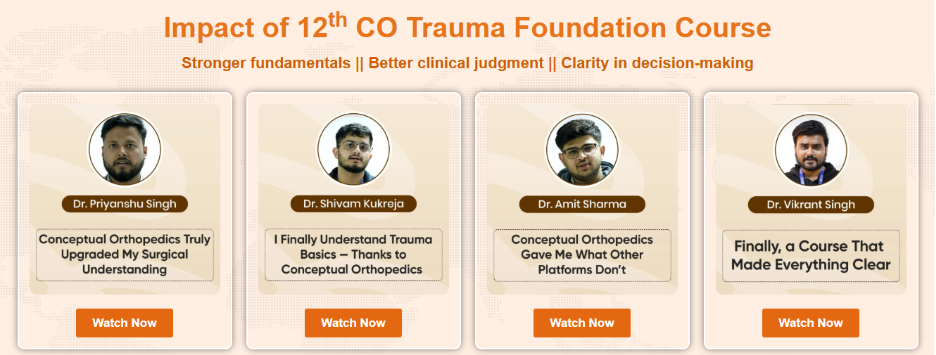
The list is too long, visit the last years CO Trauma Foundation Course’s event pages.
You Still Have Time to Join — But Maybe Not for Long
Most residents realize the importance of strong trauma fundamentals only after:
- difficult postings
- failed understanding in OT
- poor confidence during discussions
- exam pressure
- repeated confusion in fixation concepts
You still have the chance to avoid that phase.
If you genuinely want to strengthen your orthopedic basics, improve trauma understanding, and learn concepts in a way residency often cannot provide consistently, this course is worth attending.