
Estimated reading time: 5 minutes
Some academic courses feel routine—you attend, take a few notes, and move on.
This wasn’t one of them.
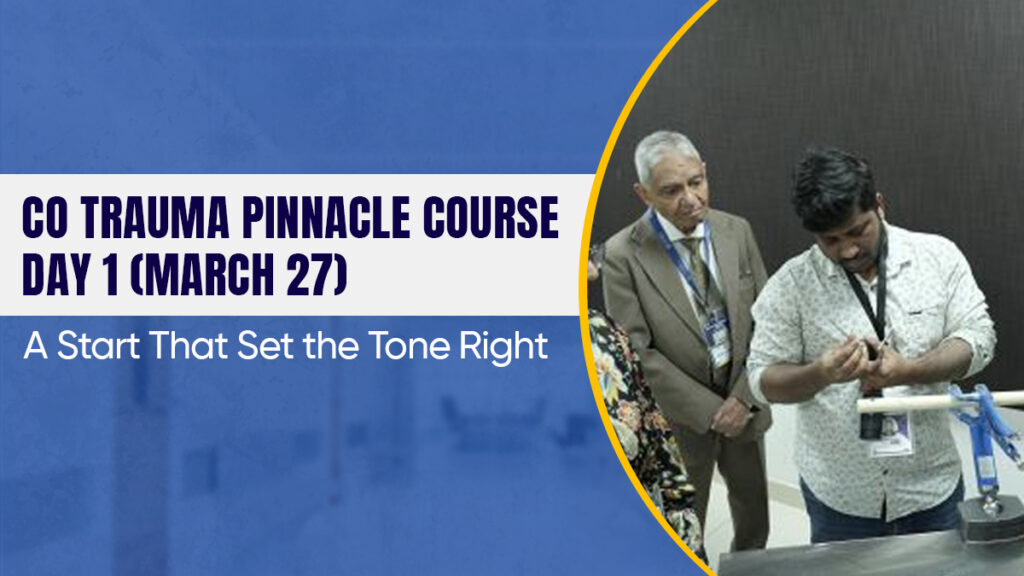
Day 1 of the CO Trauma Pinnacle Course (27th March) felt different from the start. There was clarity, there was involvement, and most importantly, there was learning that actually made sense in a clinical setting.
Residents didn’t just sit through sessions—they asked, discussed, practiced, and stayed engaged throughout. By the end of the day, it was clear that this course was going to be something much bigger than just another academic event.
Day 1: What Really Happened (and What You Missed)
If you couldn’t make it, here’s a real glimpse of how Day 1 unfolded.
Starting Strong: Inauguration & Course Introduction
The course opened with a clear plan—no unnecessary fluff. The faculty laid out exactly what would be covered and how the next three days would help both clinically and for exams.
It set the tone right from the beginning.
Proximal Humerus: More Than Just Classifications
This wasn’t just about memorizing fracture types. The discussion went deeper:
- How to decide management in real cases
- When to operate—and when not to
- Small clinical pointers that aren’t usually emphasized in books
It felt practical, not theoretical.
Simulation & Advanced Training: Where Things Got Real
This was one of the most talked-about parts of the day.
Instead of just watching, participants actually got involved—handling instruments, understanding steps, and seeing how procedures are done in real scenarios.
For many, this was the highlight.
Practical Exercise 1: Learning by Doing
After understanding concepts, it was time to apply them.
There was a clear focus on:
- Doing things step-by-step
- Avoiding common mistakes
- Building that initial confidence which most residents struggle with
Distal Humerus: Clearing the Confusion
A topic many find tricky—but here, it was broken down simply.
- Approach to complex fractures
- Fixation strategies
- Real case-based explanations
This session made things feel manageable.
TBW Practical: Getting the Basics Right
Tension Band Wiring (TBW) is something everyone studies—but not everyone feels confident doing.
This session helped bridge that gap:
- Proper technique
- When to use it
- What usually goes wrong
Forearm (Elbow to Wrist): Connecting the Dots
Instead of isolated facts, this session helped build a bigger picture:
- Principles of forearm fractures
- Importance of alignment
- Functional outcomes in real patients
Case Discussions: The Most Relatable Part
The day ended with delegate case discussions—and honestly, this is where everything came together.
Participants shared real cases, discussed doubts, and got direct inputs from faculty.
No slides. No rote learning. Just real orthopedics.
Want to See What You Missed?
We’ll be adding the CO Trauma Pinnacle Course event page link, where you can go through the sessions, highlights, and key moments from the course.
If you couldn’t attend, it’s definitely worth checking out—you’ll get a fair idea of what made this course stand out.
Why This Course Felt Different
Most residents today don’t struggle because they don’t study—they struggle because they don’t get enough practical clarity.
That’s exactly where this course delivered.
- Concepts were simplified
- Application was emphasized
- Doubts were openly discussed
- Learning felt relevant to real-life practice
It wasn’t about covering more topics—it was about understanding them better.
About Conceptual Orthopedics
If you’ve been around orthopedics prep for a while, you’ve probably heard of Conceptual Orthopedics.
There’s a reason why many residents prefer it.
The focus has always been clear:
- Build strong concepts
- Keep things clinically relevant
- Align preparation with exams like PDCET, DNB, NEET SS
Whether you’re in the middle of residency or just starting serious preparation, having the right guidance can make a big difference—and that’s where this platform fits in.
Final Take
By the end of Day 1, one thing was clear—this wasn’t just another course you attend and forget.
It actually helped people feel a little more confident about what they’re doing. And in a field like orthopedics, that matters.
Keep following us, the second part will come soon.
Stay Updated
If you don’t want to miss sessions like this in the future, stay connected.
New workshops, courses, and learning opportunities keep coming up—and being aware of them can genuinely help you make your residency smoother and more productive.
Take Your Preparation Seriously
If you’re preparing for NEET SS Orthopedics or just want to feel more confident during residency:
- Keep learning beyond textbooks
- Focus on concepts, not just notes
- Choose platforms that actually simplify things
You can subscribe to Conceptual Orthopedics to stay updated with upcoming sessions, structured courses, and focused preparation support.
Sometimes, the right guidance at the right time makes all the difference.