
Estimated reading time: 4 minutes
For years, orthopedics has been driven by clinical expertise, surgical skills, and a deep understanding of anatomy and biomechanics. While these fundamentals remain unchanged, a new force is beginning to shape the specialty—Artificial Intelligence (AI).
What once seemed like a futuristic concept is now becoming part of everyday medical practice. AI-powered tools are helping doctors analyze imaging, identify patterns, assist in treatment planning, and improve patient outcomes. Across the world, healthcare systems are exploring ways to integrate AI into clinical workflows, and orthopedics is no exception.
The message is clear: the future orthopedic surgeon will need to understand not only orthopedics but also how emerging technologies can support better clinical decision-making.
Why AI Matters for Orthopedic Residents?
As a resident or postgraduate aspirant, it’s easy to think that AI is something you’ll learn about later. But the reality is that these changes are already happening.
The next generation of orthopedic surgeons will be expected to work alongside technology, interpret AI-generated insights, and combine them with clinical judgment. This requires more than memorizing facts—it requires a strong conceptual understanding of the subject.
A doctor who understands biomechanics, fracture patterns, radiology, and clinical reasoning will always be better equipped to use AI effectively than someone who relies solely on rote learning.
That’s why learning orthopedics conceptually has become more important than ever.
How Conceptual Orthopedics Is Preparing Students for the Future?
At Conceptual Orthopedics, the goal isn’t just to help students clear exams. The focus is on helping them understand orthopedics in a way that prepares them for real clinical practice—and for the changes that are coming to healthcare.
Through concept-based teaching, clinical correlations, case discussions, and application-oriented learning, students develop the kind of understanding that remains valuable regardless of how technology evolves.
Special AI Sessions You Can Watch Right Now
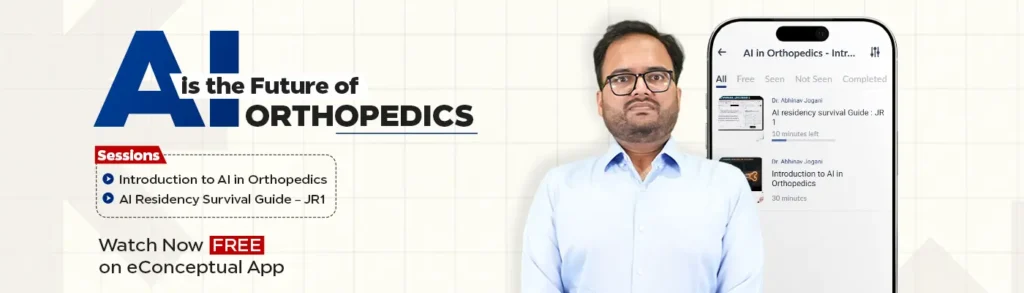
Download the eConceptual App and select Conceptual Orthopedics and watch the free sessions.
AI in Orthopedics
This session explores how Artificial Intelligence is making its way into orthopedic practice, the opportunities it creates for doctors, and why residents should start paying attention to these developments today.
AI Residency Survival Guide – JR 1
A practical session designed for junior residents, discussing how AI tools can help improve learning efficiency, knowledge organization, and day-to-day residency workflows.
AI Residency Survival Guide – JR 2
The second part builds upon the fundamentals and discusses how residents can responsibly use AI while continuing to strengthen their clinical judgment and decision-making skills.
These sessions available on eConceptual app which offers valuable insights into how technology is changing medical education and what young orthopedic doctors can do to stay ahead of the curve.
Don’t Learn AI Separately—Learn Orthopedics in a Way That Makes AI Useful
One of the biggest misconceptions about AI in medicine is that students need to become technology experts.
They don’t.
What they need is a strong understanding of orthopedics.
When your concepts are clear, AI becomes a powerful tool.
When your concepts are weak, even the most advanced technology won’t help you make the right clinical decisions.
That’s why Conceptual Orthopedics focuses on building the kind of understanding that will remain relevant throughout your career—whether you’re preparing for exams, managing patients, or working alongside the next generation of AI-powered healthcare tools.
Classes Have Already Started
The future of orthopedics is being shaped today.
If you want to learn orthopedics through concepts, clinical reasoning, and practical application—and gain exposure to emerging topics like AI—this is the perfect time to get started.
Watch Video: Introducing AI in Conceptual Orthopedics | How It Helps in Residency & Exams