
Estimated reading time: 5 minutes
If you’re doing ortho residency, you don’t really get to “choose” trauma. It just becomes a part of your daily life, casualty calls, ward cases, emergency decisions, it’s always there.
And honestly, that’s also where a lot of confusion starts.
You’ll notice pretty early what one unit follows, another might do differently. What you read in textbooks doesn’t always match what’s happening in OT. It can feel a bit all over the place.
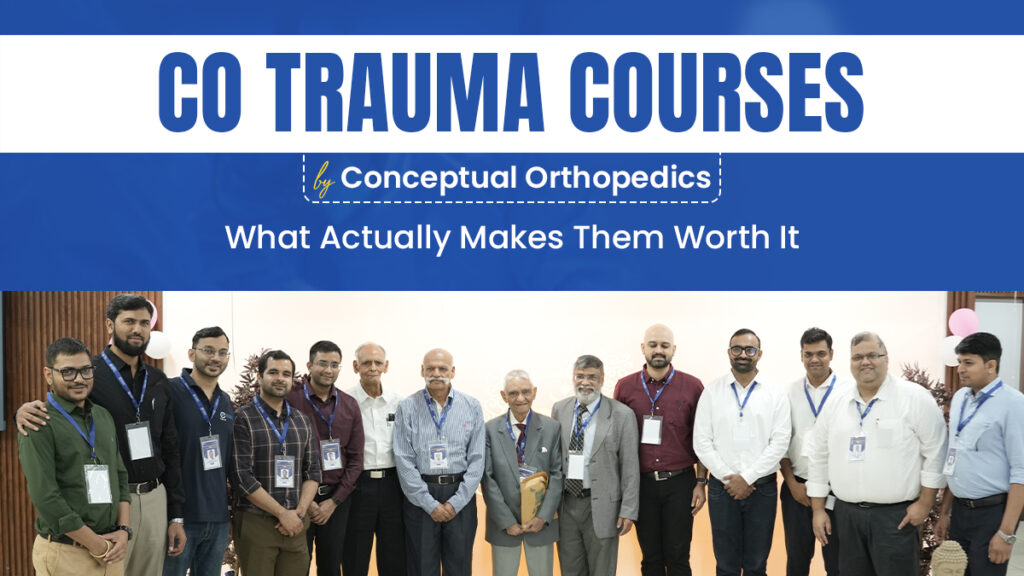
That’s exactly the gap the CO Trauma Courses are trying to fix.
Why This Course Feels Different?
Most of us are used to learning “steps”, do this, then that.
But here, the focus shifts slightly. It’s more about understanding why something is being done.
Because protocols may change, seniors may different but the principles don’t.
Once that clicks, decision-making becomes a lot clearer, even in unfamiliar situations.
That’s really the point of this course.
The Thought Behind It
The CO Trauma Foundation Course was built with a simple idea, bring students closer to people who’ve actually been doing this for years.
Not just lectures where you sit and listen.
Actual discussions.
Real questions.
Doubts that don’t get brushed aside.
It was something strongly emphasized by Prof. Dr. V.B. Bhasin, to make learning more interactive and less one-sided.
And you can feel that when you’re there, you can explore the offline course page from here for better understanding.
What You Actually Take Back From It?
It’s not overloaded with unnecessary theory. It’s more focused, more practical.
Biomechanics & Bone Healing
You finally understand what’s actually happening at the fracture site. Not just “it heals”, but how and why.
Mechanobiology, which sounds complicated at first, starts making sense in a clinical way.
Fixation—Not Just “Which,” But “Why”
Plates, nails, screws, external fixators… we all use them.
But here, the discussion goes deeper:
- Why this over that?
- What changes if conditions change?
That kind of thinking is what sticks.
Case Discussions (Probably the Most Useful Part)
Real cases. Real complications.
And more importantly honest conversations about what went wrong.
There’s a line you’ll hear often in ortho:
“If you haven’t seen complications, you haven’t done enough.”
This is where reality hits—but in a good way.
Core Concepts That Actually Matter
Things like:
- Stress–strain
- Working length
- Load distribution
These aren’t just theory topics. These are the things that quietly decide whether your fixation works or fails.
Interaction Matters
This isn’t a “note-taking” setup.
You ask. They answer.
And they don’t rush it.
That space to actually think and clarify that’s what makes the difference.
Also Helps for Exams
There are MCQs, yes.
But more than that, it changes how you approach questions. You start thinking instead of guessing.
Where It’s Been Done?
The course has already been conducted in:
- Delhi
- Mumbai
- Hyderabad
And you can see why it keeps getting repeated there’s clear value in it.
Upcoming Courses
If you’re planning to attend, these are the next ones:
CO Trauma Foundation Course
- 14th Course
Vidya Jeevan, Greater Noida
June 6–7
- 15th Course
Chennai
July 18–19
CO Trauma Pinnacle Course
- 4th Pinnacle Course
Vidya Jeevan, Greater Noida
September 11–13
Who This Is For?
It’s for CO Premium Subscribers.
And that actually makes sense—because the environment stays focused. People attending are serious about learning, not just showing up.
One Important Thing
The Foundation Course isn’t optional if you’re planning the Pinnacle Course.
It’s literally the base.
If you skip this, you’ll feel the gap later.
The Faculty
You’re learning from people who’ve spent decades in orthopedics:
- Prof. Dr. S.M. Tuli
- Prof. Dr. Sudhir Kumar
- Prof. Dr. Anil Dhal
- Prof. Dr. V.B. Bhasin
- Prof. Dr. Shantharam Shetty
- Dr. Ravinder Dimri
- Dr. Ajith Kumar
- Dr. Harpreet Singh
- Dr. Shailesh Pai
- Dr. Faheem Kotekar
- Dr. Naufal Nahas
and others.
That kind of exposure is hard to get in routine residency.
Final Thought
At some point, you realize ortho isn’t about memorizing steps.
It’s about understanding what you’re doing—and being able to adapt when things don’t go as planned.
That’s what this course helps with.
No shortcuts.
No unnecessary overload.
Just clarity.
And honestly, that’s what makes the biggest difference when you’re actually standing in OT making decisions.